Hello, this is Azat Miftakhov. For technical reasons, New Year’s Eve happened a week ago. I received many warm, touching letters and cute pictures. Reading them, I experienced many positive emotions. I would like to answer everyone, but return letters are very difficult for me. Just like public addresses, which I make extremely rarely. The thing is that I am too demanding of myself and I am afraid that my words are imperfect. I worried about my insurmountable perfectionism for a long time, until one day I accidentally learned about similar problems with writing texts from such a luminary of science as Lev Davidovich Landau. It even happened that his co-authors designed joint works for him. After that, I partly accepted this feature of mine. But only partly, because it still bothers me that you expect answers from me! And on my birthday, I found the strength in myself, and I want to express my gratitude to you. Thank you for all the support I have received from you over the years. For your letters and wishes, for the events you have organized: from large rallies in support of political prisoners in different countries of the world to bold actions in totalitarian Russia (like, for example, the recent action at the Lomonosov monument in support of me and Dima Ivanov). I am glad that political activity does not fade away, despite the difficult times. What you do greatly helps political prisoners and their loved ones, but also demonstrates mass disagreement with the policies of the current regime. With your support and solidarity, the walls will come down!
Category: Uncategorized

As we reported earlier, on August 1, 2024 a large scale prisoner swap between Russia and the western countries took place in Turkey, resulting in the release of a substantial number of Russian political prisoners. Unfortunately, Azat Miftakhov was not a part of that swap, and he remains imprisoned in Russia, after his March 2024 conviction in his second, entirely fabricated by the FSB, “justifying of terrorism” trial. On August 21, 2024, the AMS Committee on the Human Rights of Mathematicians has sent a letter to the U.S. State Department bringing the case of Azat Miftakhov to their attention and urging that Azat be included in any future prisoner swaps with Russia. We are grateful to the AMS for this action and for their support of the efforts to obtain Azat’s freedom, a goal that remains of paramount importance for the international mathematical community.
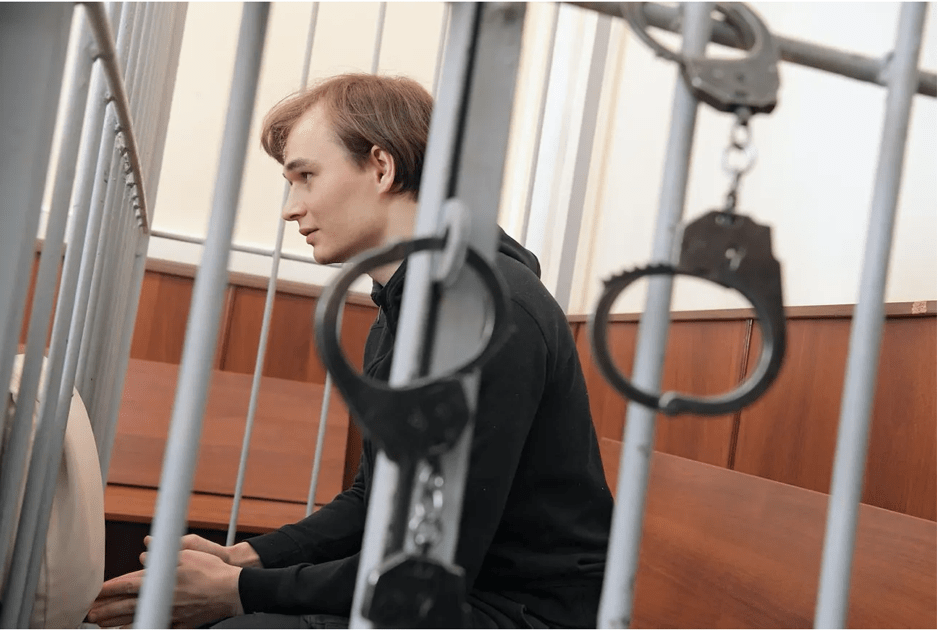
According to media reports, a major prisoner exchange between Russia and some Western countries occurred in Turkey on Thursday, August 1, 2024. As part of this exchange, Wall Street Journal reporter Evan Gershkovich and several Russian opposition politicians, including Ilya Yashin and Vladimir Kara-Murza, who had been imprisoned in Russia, were released.
We welcome the release of Russian political prisoners as part of this swap.
Unfortunately, Russian mathematician and political prisoner Azat Miftakhov was not included in this exchange. He remains incarcerated in Russia after his latest conviction in March 2024, where he received a four-year prison sentence on fabricated charges of “justifying terrorism.” Azat has been imprisoned since February 2019.
While Azat may not hold strategic value in the current global power struggle, he is highly significant to the mathematical and scientific communities. As a young Russian researcher imprisoned for his political views, Azat’s case is emblematic of the repression faced by academics, intellectuals, and young people in Russia and beyond. We call for his immediate release and hope that his situation will be considered in future exchanges.
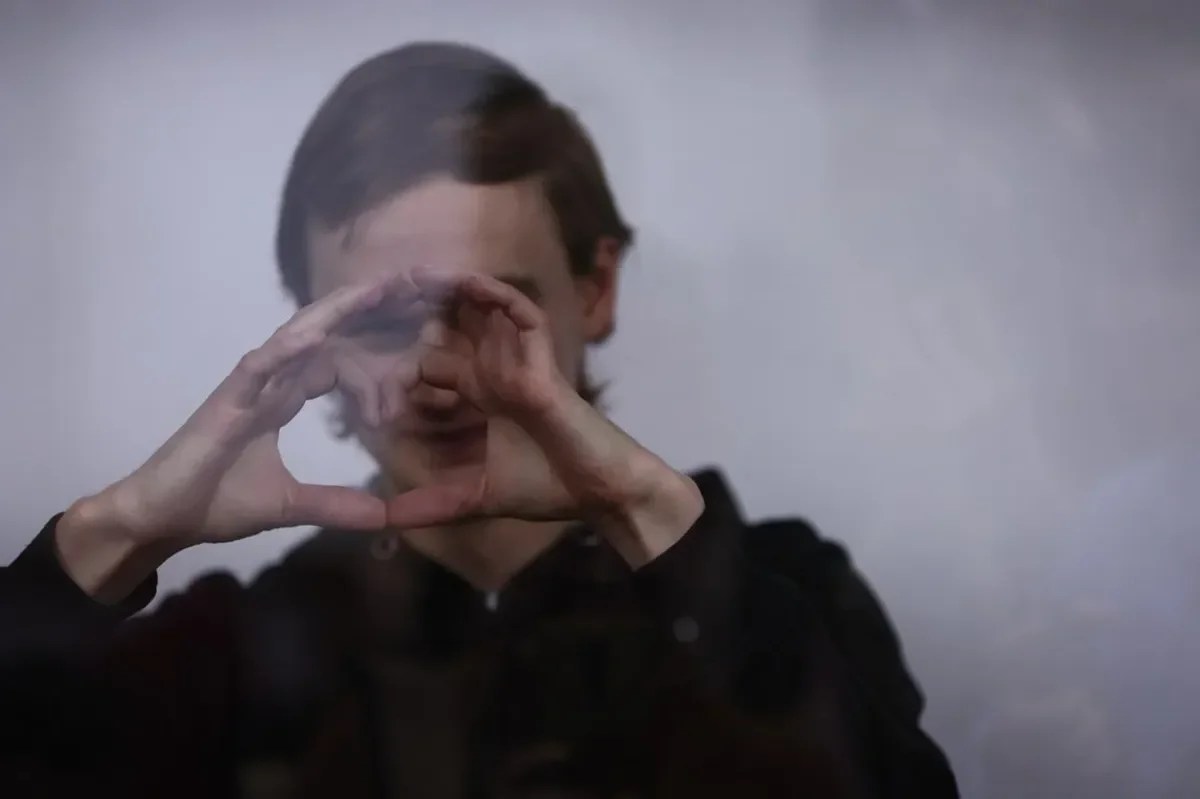
On Thursday, March 28, 2024 a military court in Yekaterinburg found Azat Miftakhov guilty of “justifying terrorism.” Although the prosecutor requested a sentence of three years, the judge imposed a lengthier sentence of four years imprisonment, with 2.5 years in prison followed by 1.5 years in a strict regime penal colony. Azat was not allowed to finish his last word before the verdict was read although he was able to say that the charges are fabricated and based on false testimony concocted by the FSB.
This new verdict against Azat constitutes a grotesque injustice and a blatant case of political persecution by Russia’s authoritarian regime. Azat is a talented young mathematician who already spent over five years behind bars on a series of fabricated politically motivated charges since his initial arrest in February 2019. He endured mistreatment and torture by the authorities wile in detention. When Azat was released from the prison colony in Omutninsk in September 2023 to start serving parole in the infamous “broken window” case conviction, the FSB immediately re-arrested him on a bogus new “justifying terrorism” charge. Azat recently marked his 31st birthday while imprisoned.
We continue to demand Azat Miftakhov’s immediate and unconditional release. The international mathematical community stands with Azat.

Nous remercions la rédaction de Mediapart de nous avoir autorisé à reproduire cet article d’Antoine Perraud.
Le mathématicien libertaire russe Azat Miftakhov, déjà condamné lors d’un procès truqué, fait face jeudi 29 février à une nouvelle mascarade judiciaire qui devrait le renvoyer en colonie pénitentiaire. De Moscou, sa femme, Elena Gorban, témoigne pour Mediapart.
MediapartMediapart a déjà évoqué le cas d’Azat Miftakhov, mathématicien russe d’origine tatare proche de la mouvance anarchiste, opposé au système Poutine, arrêté en février 2019 puis condamné en janvier 2021. Les services de sécurité (FSB) lui ont fabriqué un dossier pour l’associer à un prétendu « réseau » terroriste en lui imputant, à tort, d’avoir brisé la fenêtre d’un local du parti Russie unie, la formation poutinienne.
Envoyé pour « fait de vandalisme » dans une colonie pénitentiaire à Omoutninsk (entre Kirov et Perm, à plus de 1 000 kilomètres à l’est de Moscou), Azat Miftakhov était libérable en septembre 2023. Toutefois, le FSB forgeait contre lui un nouveau dossier encore plus grave, de façon à renouveler son bail dans les geôles du fait d’un autre chef d’accusation, le faisant passer de la catégorie de « hooligan » à celle de « terroriste ».
Cela n’a pas manqué. À peine sorti de prison le 4 septembre dernier, ayant juste eu le temps d’embrasser sa mère et de lui promettre de « tenir », Azat Miftakhov repartait illico à la case prison, selon le système que les Russes appellent « carrousel ». Un nouveau jugement doit tomber jeudi 29 février.
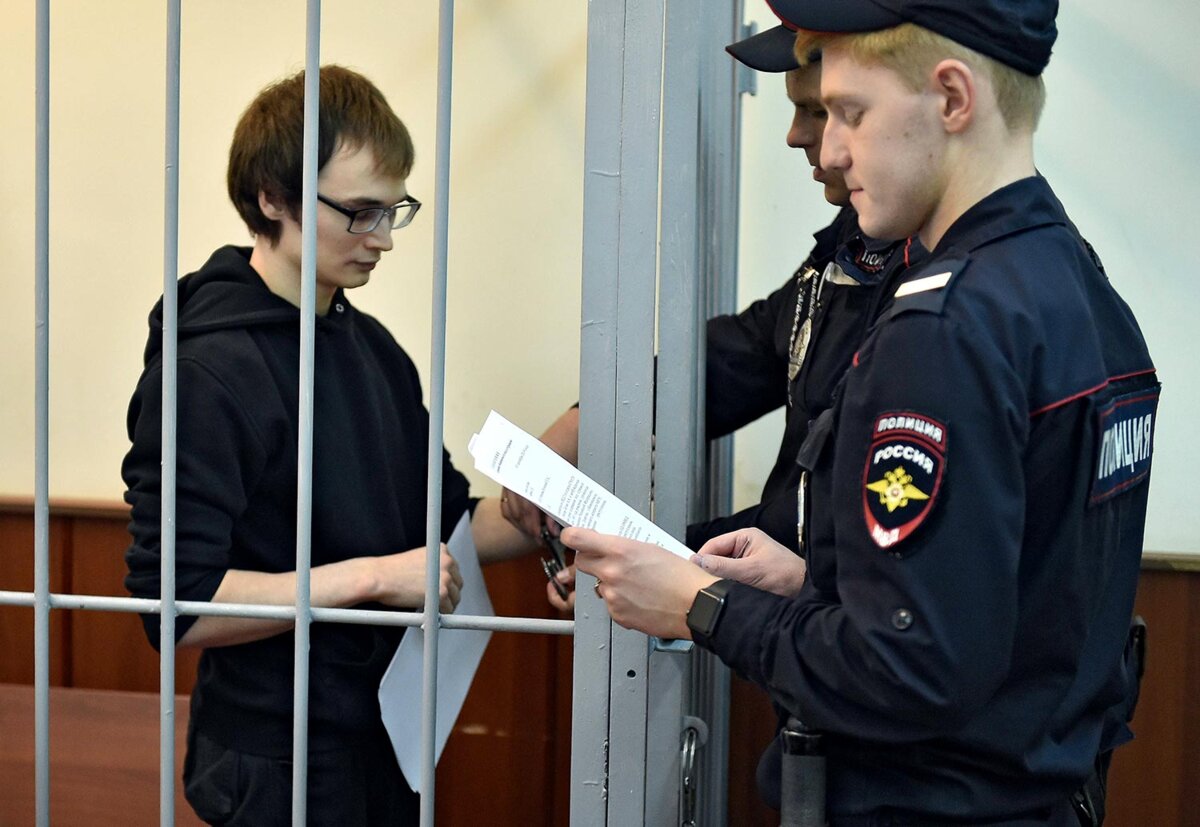
Azat Miftakhov avant son audience par le tribunal à Moscou, le 5 septembre 2019. © Photo Ivan Vodop’janov / Kommersant / Sipa USA
Nous avons pu joindre à Moscou Elena Goban, l’épouse d’Azat, libertaire comme lui. C’était lundi 26 février et elle s’apprêtait à prendre un train de nuit pour Ekaterinbourg, dans l’Oural – trente heures de voyage –, afin d’assister au procès puis au verdict devant s’abattre sur son mari. Celui-ci fait partie des plus de 3 000 prisonniers politiques répertoriés par Memorial, alors que la Russie n’en compte aucun officiellement.
Mediapart : Quel est le statut d’Azat Miftakhov ?
Elena Gorban : Juridiquement et formellement, c’est un détenu de droit commun : un voyou qui a fait une bêtise et que le pouvoir, épaulé par la justice, tente de faire passer pour un criminel en puissance – tandis que le peu de forces encore vives de la société russe l’appréhende telle la victime d’une vindicte politique.
L’opposition russe, en tout cas les structures qui subsistent, se voit criminalisée par le régime. L’exemple le plus connu étant Navalny et ses équipes, qui ont toujours voulu agir de manière pacifique et dans le cadre de la loi. Les médias gouvernementaux les ont pourtant continuellement présentés comme des terroristes, des extrémistes.
Et même, ce qui est un comble quand on connaît leur lutte contre la corruption en Russie, comme des fraudeurs, toujours accusés de se livrer à des activités économiques occultes…
Votre mari, lors de sa détention, a été victime de provocations du FSB, destinées à lui faire perdre la protection que lui confère sa condition de prisonnier politique, pourtant non reconnue…
Oui, s’il n’y a pas de statut, il y a une situation de fait, reconnue dans les établissements pénitentiaires, en Russie, où demeurent des poches de soutien, et bien sûr à l’étranger où se manifestent des campagnes pour sa libération. Tout cela crée une sorte d’aura, que le pouvoir et ses relais s’appliquent à détruire.
Le FSB a par exemple détourné puis rendu publics des clichés relatifs à l’orientation bisexuelle d’Azat pour qu’il soit discriminé et livré en pâture. Là encore, aucun statut des prisonniers mais un état de fait : une vie sexuelle considérée comme déviante fait dégringoler dans les basses castes officieuses de la hiérarchie carcérale, au point de vous rendre la vie très difficile – de la part des geôliers comme des codétenus.
Quel est le quotidien de sa vie de prisonnier ?
Azat a été placé dans une colonie pénitentiaire très contrôlée, une « zone rouge » aux conditions très strictes : le règlement doit être appliqué et respecté à la lettre, comme nulle part ailleurs. Il faut saluer chaque représentant du personnel selon un protocole précis. Chaque manquement est puni.
Tout est fait pour le piéger. Il a une demi-heure pour effectuer le ménage de la cellule, mais il n’est jamais prévenu du moment où doit avoir lieu ce nettoyage. En conséquence, au lieu de passer pour lui notifier l’heure, les gardiens passent pour constater que rien n’a été fait et l’envoyer au mitard.
Tout est conçu pour humilier, briser. Il lui est arrivé de n’avoir droit qu’à une conversation téléphonique par mois, quasiment impossible à mener à bien, tant la file d’attente est importante devant l’unique cabine téléphonique de l’établissement dans le temps imparti.
La seule façon de gagner un petit espace de tolérance et de paix, c’est de collaborer activement avec l’administration, ce qu’Azat a évidemment refusé de faire.
Comment tient-il ?
C’est émotionnellement très dur pour lui. Chaque infraction qui lui est reprochée permet de l’isoler davantage, pour éviter qu’il ne noue des liens avec d’autres prisonniers risquant alors de subir son influence.
Il lui est pourtant arrivé de trouver des interlocuteurs avec lesquels échanger, sinon se confier. Il a dû déchanter en découvrant que l’un d’entre eux était un mouchard, dont le témoignage à charge ne fait qu’alourdir le dossier d’Azat en vue des prochaines condamnations…
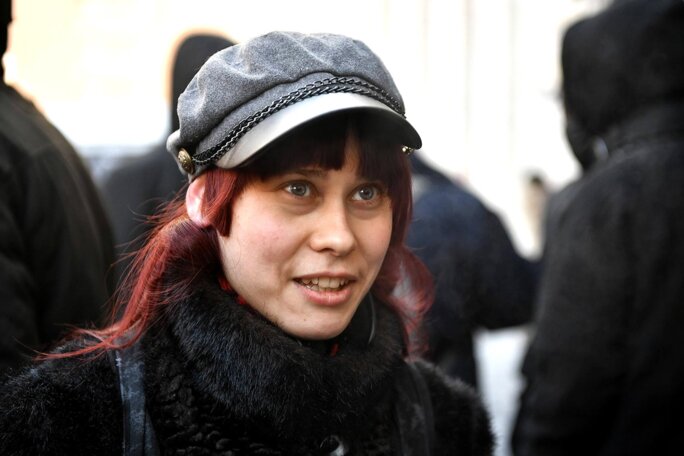
Elena Gorban devant le tribunal Golovinski après l’annonce du verdict concernant Azat Miftakhov à Moscou, le 18 janvier 2021. © Photo Ivan Vodop’janov / Kommersant / Sipa USA
Je ne vous cache pas qu’il a été obligé, pour tenir, d’en passer par les antidépresseurs. Surtout après l’invasion de l’Ukraine, quand il s’est rendu compte que la plupart des gens incarcérés soutenaient la prétendue « opération spéciale ».
Alors il s’est réfugié dans le travail manuel, d’abord dans une scierie, ensuite dans un atelier de confection. Il n’avait plus la force ni le courage de se tenir aux buts qu’il s’était fixés au début de sa détention : continuer ses travaux mathématiques et apprendre l’anglais.
Azat a subi un rude contrecoup lorsqu’il s’est tardivement rendu compte que l’état de guerre contre l’Ukraine n’avait pas eu l’effet escompté : aucun changement politique à l’horizon.
Le travail est à peine rémunéré – la majorité du salaire de misère sert de toute façon à payer sa « pension » puisque la détention a un coût en Russie. Il ne se consacrait pas à sa besogne pour les quelques dizaines d’euros qu’il peut économiser en un an de travail, mais précisément pour échapper à l’angoisse, à la solitude et aux brimades. Au point de ne pas bénéficier intégralement des rares congés : Azat demande à reprendre sa tâche au plus tôt.
Comment se tient-il au courant ?
À contretemps. La censure sévit. Lui n’a pas le droit d’évoquer les conditions de sa détention ni surtout le cas de ses codétenus. Quant à mes courriers, ceux de sa mère ou de ses amis et camarades, ils sont caviardés quand certains passages personnels déplaisent à l’administration ; ou carrément passés à la trappe si l’actualité ou la politique prennent trop d’importance aux yeux des censeurs.
Par conséquent, Azat a subi un rude contrecoup lorsqu’il s’est tardivement rendu compte que l’état de guerre contre l’Ukraine n’avait pas eu l’effet escompté : aucun changement politique à l’horizon.
Aucun changement, sinon un durcissement du pouvoir ?
Oui et non. Le pouvoir a toujours été dur et cruel, mais nous n’étions qu’une petite minorité à nous en rendre compte et à subir sa brutalité. Par la force des choses, beaucoup plus de gens en sont désormais conscients, obligés qu’ils sont d’ouvrir les yeux. Mais il y a encore une majorité de la population russe qui ne peut ou ne veut pas savoir. Et qui continue de vivre sans y comprendre rien.
En dehors de la guerre demeurent d’autres sujets sur lesquels il nous est possible de nous exprimer : mais à voix un peu plus basse et en ne sachant pas jusqu’à quand ce sera possible.
En revanche, la question des LGBT vire à l’obsession, et la frénésie répressive tourne à la farce féroce et implacable : on peut se retrouver au cachot deux semaines pour figurer sur une photographie avec des anneaux couleur arc-en-ciel – c’est un exemple véridique, parmi d’autres, que je vous cite.
La justice se contente d’infliger des condamnations de plus en plus lourdes. Elles sont décidées en amont, sinon par le Kremlin, du moins par des intermédiaires politiques fiables et zélés. Et ce, depuis un an déjà comme en témoigne la peine énorme infligée à l’opposant Vladimir Kara-Mourza en avril 2023 : vingt-cinq ans de détention !
Face à la « verticale du pouvoir » de Poutine, existe-t-il une forme de solidarité horizontale encore à l’œuvre dans la société russe ?
Il y a quelques manifestations, plus sporadiques que massives, de résistance, comme l’envoi groupé de lettres écrites aux prisonniers politiques par des citoyens et des citoyennes qui se réunissent pour ce faire. Certains Russes courageux vont également assister aux audiences des tribunaux, quand elles sont publiques.
Je peux encore citer les contributions financières organisées pour payer les frais d’avocat. Sans parler de celles et ceux qui se mobilisent et sonnent le tocsin dès qu’un prisonnier souffre gravement de ses conditions d’incarcération, afin que lui soient prodigués les soins nécessaires. Ce fut notamment le cas pour Igor Baryshnikov, atteint d’un cancer de la prostate, mais payant de la prison son opposition à la guerre en Ukraine.
Je ne suis pas du tout du même bord que Navalny, mais ma compassion est immense.
Tout cela peut apporter une aide décisive, même si les autorités pénitentiaires n’en font souvent qu’à leur tête dans des lieux reculés de la Russie, face à une solidarité qui s’organise généralement dans quelques grandes villes du pays.
Tout cela peut aussi avoir l’effet inverse, le Kremlin voulant marquer qu’il agit comme bon lui semble, quelle que soit la pression, venant de l’intérieur comme de l’extérieur du pays, à laquelle il n’entend pas céder. En témoigne le sort tragique de Navalny.
Quel a été l’effet de sa mort ?
Comme beaucoup, j’ai d’abord tenté de me raccrocher à l’idée qu’il s’agissait d’une fausse nouvelle en voyant s’afficher l’annonce de sa mort à travers les sites des chaînes publiques sur Telegram. Quand il a fallu se rendre à l’évidence, je n’ai évidemment pu que trembler pour Azat, auquel il pourrait arriver la même chose.
Je ne suis pas du tout du même bord que Navalny, mais ma compassion est immense. Je ne suis pas allée déposer des fleurs sur certains monuments de Moscou dédiés aux victimes des répressions politiques, dans la mesure où j’ai déjà été condamnée au civil avec sursis.
Une nouvelle condamnation pourrait me conduire au pénal. Sans oublier l’aspect économique. Une première condamnation vous fait écoper d’environ un mois de salaire. Une deuxième vous coûte les yeux de la tête : plus de six mois de traitement, alors que ma situation professionnelle est déjà rendue précaire…
Comment pouvez-vous craindre de déposer une fleur à Moscou et parler sans peur à un journaliste français comme vous le faites actuellement ?
D’abord il faut vous dire que le système Poutine ne consiste pas à enfermer le plus de gens possible, mais suffisamment de gens pour que le reste de la population vive dans la peur. Une simple considération à l’encontre de la guerre en Ukraine sur Internet peut parfois conduire en prison. L’un des chefs d’accusation le plus souvent mobilisés, à tort et à travers, est l’« apologie du terrorisme ».
S’exprimer dans l’espace public russe est devenu risqué. Répercuter un article d’un média russe d’opposition catalogué par le pouvoir comme « extrémiste » ou « agent de l’étranger », et parfois même seulement citer un tel titre peut avoir de graves conséquences.
En règle générale, nous nous sentons obligés de nous retenir d’exprimer un avis sur la plupart des questions politiques et sociales tant pèse l’absence de liberté.
Toutefois, il n’existe pas encore d’interdiction directe de s’ouvrir à un journaliste étranger sur la persécution que subit Azat. Si ce n’est pas prohibé, c’est que ce n’est pas dangereux ; ce n’est pas dangereux puisque ce n’est pas prohibé. Nous en sommes là, dans un équilibre fragile, instable, et qui n’est peut-être pas appelé à durer…
Que pouvons-nous vous souhaiter pour les jours et les semaines à venir ?
Comme pour tous les pays qui connaissent ce genre de situation : des changements globaux de façon que la justice soit enfin restaurée. Mais nous n’en sommes pas là !
Si je passe de la situation générale à celle, particulière, d’Azat, il faut souhaiter ce qui n’arrivera pas : qu’il s’en tire avec une amende et que le tribunal ne sorte pas de sa manche – et préparé de longue main – un nouveau chef d’inculpation qui le reverra pour quelques années au cachot.
Nous sommes des anarchistes, donc idéologiquement formés et conscients. Nous savons d’où vient ce pouvoir et ce dont il est capable. Si bien que nous ne vivons pas de souhaits, mais de luttes.
Pourtant, même quand il y a si peu d’espoir comme en ce moment, savoir que d’autres, en France et en Europe, se battent à l’unisson de notre combat nous fait du bien. Nous le ressentons ainsi et je tiens à vous le dire, en toute gratitude.
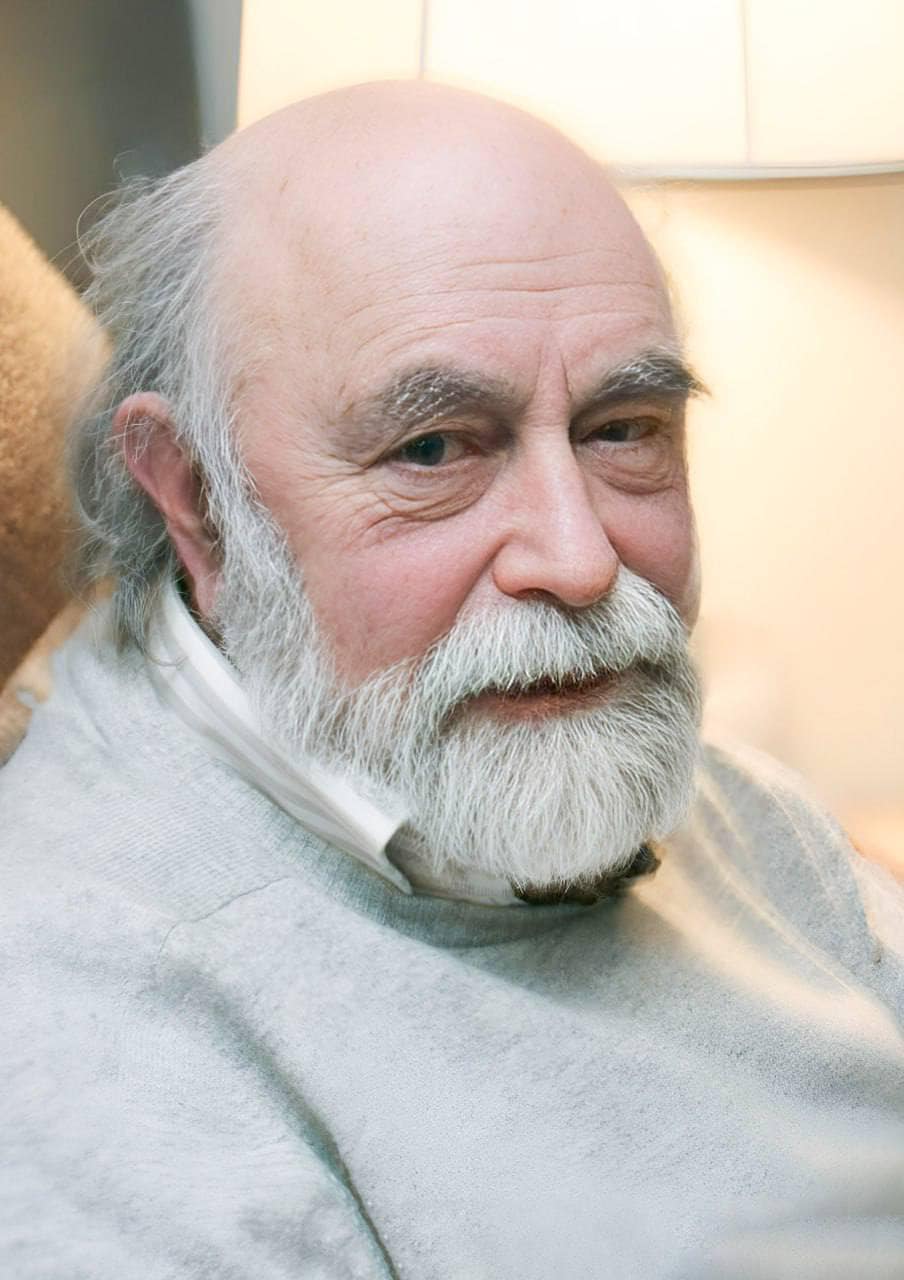
The Azat Miftakhov Committee is saddened to report the death, on February 14, 2024, from a sudden medical event, of the renowned Russian mathematician Anatoly Moiseevich Vershik. Anatoly Vershik made major contributions to many areas of mathematics, including ergodic theory, dynamical systems, Lie groups, group theory, functional analysis, and others. His work on the study of random walks and Poisson boundaries has been particularly influential.
Vershik was also a prominent human rights, pro-democracy and anti-war activist in Russian academia. He actively supported Azat Miftakhov from the time of Azat’s initial arrest in February 2019 and through Azat’s subsequent imprisonment. Vershik was a panelist for the Azat Miftakhov Day on June 16, 2021, organized by our committee.
Vershik was also a forceful voice against Russia’s brutal invasion of Ukraine. All these activities put him increasingly at risk in today’s Russia.
Anatoly Vershik’s death is a great loss for Russian mathematics and for the international mathematical community.

The premier Russian human rights organization Memorial is conducting an urgent fundraising campaign to help Azat Miftakhov with his current criminal case and the upcoming trial on the trumped up charge of “justifying terrorism.” Memorial is trying to raise 5,000 Euros to help cover Azat’s legal expenses in this case. The fundraising campaign is conducted outside of Russia, and the contributions, which can be made at this link, are not affected by various sanctions against Russia.

The group “Solidarité FreeAzat” is organizing a campaign “1001 letters to Azat Miftakhov” of writing letters of support and encouragement to Azat Miftakhov. The letters, which will be forwarded to Azat by the campaign organizers, can be e-mailed to libertepourazat@gmail.com or submitted via one of the two google docs forms: in Russian, in English or French. Both forms provide the option of signing a standard letter. Letters submitted in English or French will be translated to Russian by the organizers before being forwarded to Azat. All of the letters will have to pass the Russian prison censors.
There have also been some recent developments in Azat’s new criminal case, on the fabricated “justifying of terrorism” charge. Azat was given a detailed charging document by the prosecution. The document heavily relies on the testimony of Azat’s former fellow prisoner at the Omutninsk colony, Trushkov, whom the FSB apparently turned into an enthusiastic cooperating witness and who provided various made-up claims to the prosecution. Like the “broken window” case, the new case also includes the testimony of a “secret” government witness.
A court in Kirov upheld various artificial administrative punishments imposed on Azat this summer at the Omutninsk colony. A subsequent appeal by Azat was denied on January 23. Azat’s lawyer will appeal further, but the chances of success are slim. Ultimately this means that after the expected conviction in the upcoming trial Azat will be held in stricter conditions as а “malicious violator of the rules.”
At a hearing on January 30 a court in Yekaterinburg extended Azat’s preliminary detention until April 16, 2024. The court relied on the absurd pretext, based on the claims of prison informers, that, if released, Azat intends to travel to Ukraine. Azat is still being held at SIZO in Kirov, but he is now expected to be transferred to Yekaterinburg, where the “justifying of terrorism” trial will take place. Unlike Azat’s previous trial, this trial is expected to be short and last only a few hearings, followed by a quick conviction and sentencing.
Azat very much needs the support and solidarity of the international mathematical community in this difficult time. We continue to stand with him.
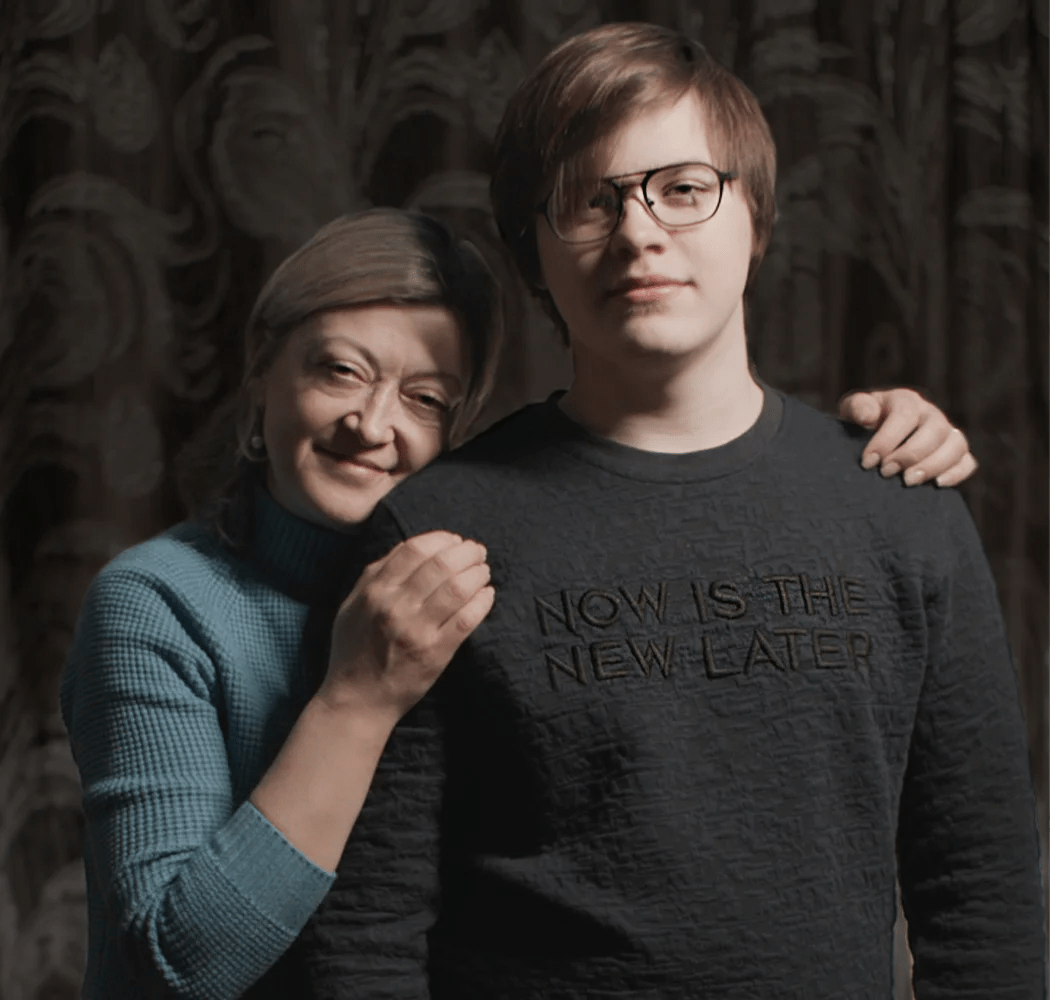
Nikita Uvarov, a teenager from Kansk who has been originally arrested for the FSB in June 2020 at the age 14 in the so-called “Minecraft” plot, is currently being held in SIZO (temporary detention center) in Kansk. At the time of his arrest, Nikita and two other 14-year-old boys were caught by the FSB posting flyers in support of Azat Miftakhov on the wall of a local FSB office. The boys were eventually criminally charged and prosecuted for supposedly being an anarchist terror cell. Nikita refused to cooperate with the authorities and in February 2022, at the age of 16, a special military court found him guilty of “terrorist training” and sentenced him to five years in a penal colony. Like Azat Miftakhov, Nikita Uvarov is widely viewed as a political prisoner and has been formally recognized as such by Memorial.
Nikita started serving his sentence at a juvenile correctional colony. However, he recently turned 18 and according to a court decision he is supposed to be transferred to an adult penal colony to serve out the rest of his sentence there. While Nikita is appealing that decision, he is being temporarily held in SIZO-5 in Kansk.
While imprisoned, Nikita had been admitted to a college in Izhevsk where he is supposed to study graphics design remotely, via online lectures. The administration of SIZO-5 does not allow the use of computers or video, and thus far they have also not allowed Nikita to receive printed study materials which his family members have been trying to send him.
If Nikita Uvarov does get transferred to the adult prison colony, the concerns about his safety and health will greatly increase. The case of Nikita Uvarov remains one of the most outrageous examples of human rights abuses by Putin’s regime, involving criminal prosecution of children on trumped up political charges.
Chandler Davis passed away last year at 96. He fought the good fights, from the Vietnam war to support for Palestine. The US sent him to prison for his activities (one of his early papers, written from a Connecticut jail, ironically acknowledges the support of the penitentiary administration), he was suspended from the University of Michigan, and he never again could find a position in a US university. He spent his academic career at the University of Toronto. He was a member of the Azat Miftakhov Committee since its creation in 2020. His last public intervention, made literally from his bed in hospital shortly before he died, was in favour of Azat Miftakhov.
Chandler’s leaves a rich literary legacy, consisting of poetry, science-fiction, and essays. He was for years the editor in chief of the Mathematical Intelligencer, which has been extremely influential in popularizing mathematics. He was a beacon for all those who do not despair of human nature, and this book may revive him for those who did not have the privilege of knowing him during his life.
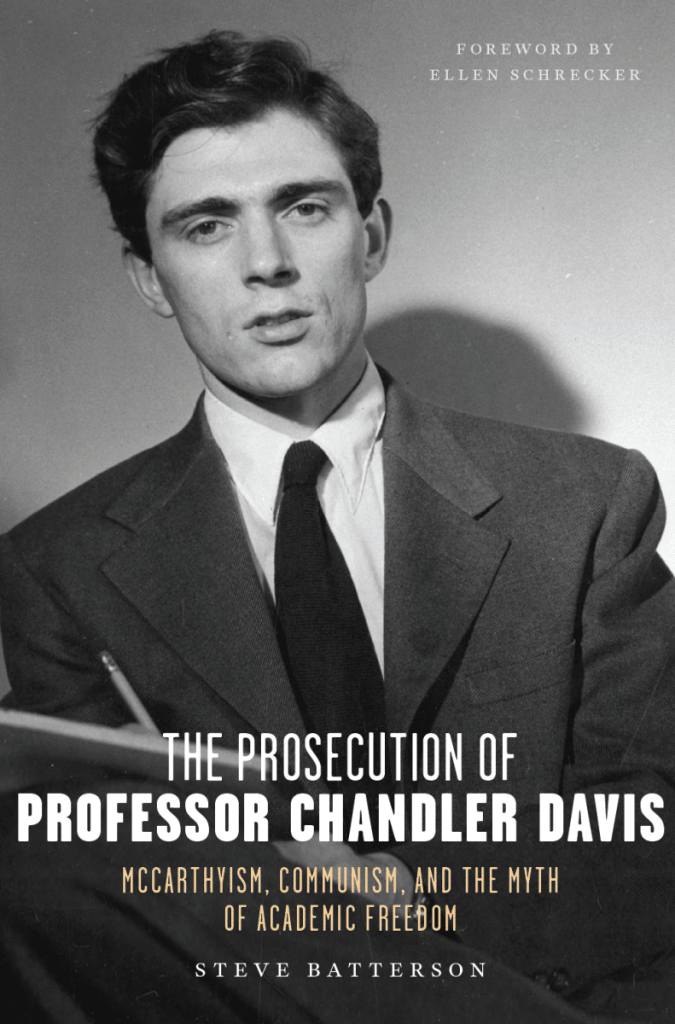
The Prosecution of Professor Chandler Davis: McCarthyism, Communism, and the Myth of Academic Freedom
by Steve Batterson
$16.00 / 200 pages / 978-1-68590-035-9
From the Foreword, by Ellen Schrecker
The American left has few heroes. We specialize in martyrs like Joe Hill, Albert Parsons, and Malcolm X, and masses like the thousands of young women in the 1909 Shirtwaist strike and the Black teenagers who defied the German Shepherds of Birmingham, Alabama, in 1963. But we also need to be reminded of those individual heroes who, like Chandler Davis, thrust themselves into history because of their intense commitment to a better world.
In this all-too-timely exploration of Davis’s encounter with McCarthyism during the late 1950s and early 1960s, Steve Batterson shows us how one principled radical managed to stand up against the Cold War witchhunt. Today, as we confront an equally, if not more serious, threat to political dissent and free expression, perhaps Davis’s story can inspire similar resistance to the right’s current attack on our democratic polity.
A radical activist both before and after he was hired to teach mathematics at the University of Michigan in the early 1950s, Chan, as he was called by those who knew him, had been expecting a summons from the witchhunters. When he received his subpoena from the House Un-American Activities Committee (HUAC) late in 1953, he already knew that he would not tell its members about his political beliefs and activities. But instead of invoking the Fifth Amendment as so many “unfriendly” witnesses, including his own father the year before, had done in order to avoid prosecution for contempt of Congress, Chan decided to rely on the First Amendment’s protection of free speech and association. He knew that tactic would be a long shot, but he hoped to pressure the Supreme Court to reverse its earlier acquiescence in the Cold War’s Red Scare. As expected, he was not only convicted, serving a six-month sentence in the Danbury Federal Penitentiary, but he was also fired by the University of Michigan and blacklisted by the nearly 150 U.S. mathematics departments to which he applied for a job.For Chan, his legal battle and struggle against the blacklist was part of a lifelong crusade against political repression. Born to a family of rebels that included ancestors on both sides of the Revolutionary War, a family home that was a stop on the Underground Railroad, a great-grandfather who served as a bodyguard to the abolitionist Wendell Phillips and became a war hero after he was wounded at Antietam, and parents who drifted in and out of the Communist Party (CP) during and after the 1930s, Chan’s political activities began in his teens and continued throughout the rest of his life. He joined the CP but did not follow those policies he disagreed with and quietly dropped out a year before his HUAC hearing.
Although punished for his politics, Chan never disavowed his earlier activities or saw himself as a victim. Instead, he viewed his confrontation with HUAC and the following inquisition at the University of Michigan as an opportunity. He willingly risked both his freedom and his career to expose and perhaps even put an end to the mainstream establishment’s willingness to quash left-wing political dissent. That his attempt to convince the Supreme Court to reverse its failure to protect the First Amendment almost succeeded is just one of the surprises that this book reveals. Based on his prodigious research in institutional archives, FBI files, and interviews, Batterson speculates that had Chief Justice Earl Warren not acquiesced in his colleague Felix Frankfurter’s refusal to accept a reference to the First Amendment in the draft of an earlier decision about HUAC, Davis might well have won his case.
Instead, in the Supreme Court’s June 1959 5–4 decision in the case of the former Vassar instructor Lloyd Barenblatt that was to govern Chan’s appeal, Justice John Marshall Harlan based the majority’s opinion on a demonized stereotype of American Communism as a Soviet-led conspiracy to destroy the United States government. For that reason, Harlan explained, the Court “has upheld federal legislation aimed at the Communist problem which in a different context would certainly have raised constitutional issues of the gravest character”…. In short, the Court’s conservative majority assumed, in a flagrant denial of reality, that the small and battered Communist Party posed such a threat to American security that it overrode the Founding Fathers’ commitment to free speech….
 The case of Azat Miftakhov